This classroom tool provides a powerful framework
By Kristin Clark Taylor
Step into Stephen Readyoff’s classroom and you’ll definitely hear the sound of music.
But you’ll hear the sounds of academic growth and social development as well.
That’s because Readyoff, a Music Specialist at Henrietta Lacks Elementary in Loudon County, Virginia, is deeply passionate about using the power of music as a vehicle for growth, exploration, and self-discovery.
He also uses music as a means of reinforcing positive behavior and healthy habits – and he’s equipped with the tools and techniques to get the job done.
Readyoff is Ready with Rewards
The Virginia educator speaks with passion, humility, and a strong sense of collective purpose.
“Our entire county of Loudon places priority on reinforcing positive behavior,” he says.
Loudon County, he explains, implements Positive Behavioral Interventions and Supports (PBIS), “because it’s a tested, data-driven method that shows clear results in terms of increased student participation and positive behavior in our students.”
PBIS is an evidence-based framework that uses data and strategies to create positive, predictable, and safe learning environments by teaching and rewarding good behavior, reducing problem behaviors, and improving academic and social outcomes for all students.
You can hear the excitement and pride in his voice as he talks about the cool tool he uses to help incentivize these behaviors in his classroom.
Which cool tool does he trust most?
QRewards, an innovative system created by QuaverEd that allows teachers to reward students for positive behavior by using QuaverNotes, a virtual currency that students can redeem for rewards.
The system encourages and incentivizes students to develop healthy, positive habits over time – inside and outside the classroom.
To help paint the picture, Readyoff shares one of his own screenshots to demonstrate how he brings the reward system to life in his own classroom.
Take a peek (below).
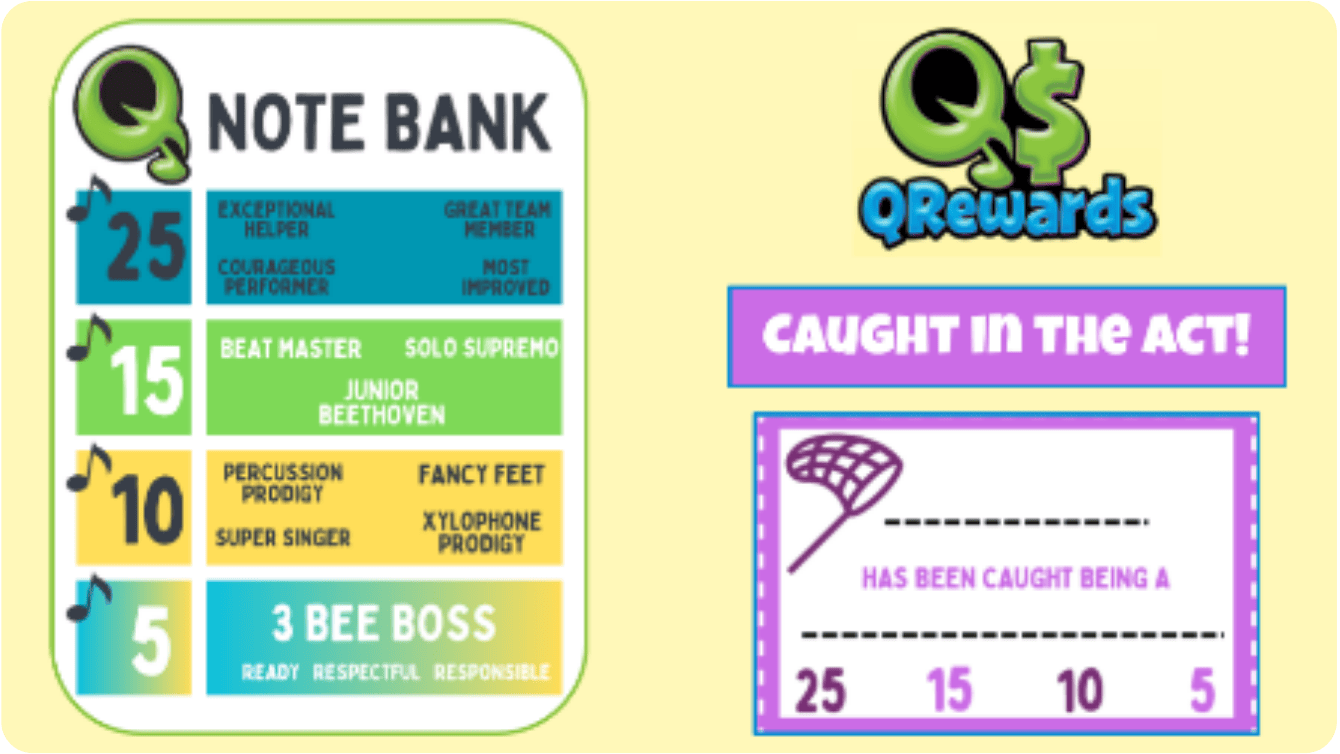
“This is a pretty basic screenshot of what we show kids during the first week of school,” Readyoff explains.
“This is when we talk about what QuaverNotes are, how to earn them, and we also talk about why certain notes are worth more.”
He explains that the lower point denominations are “expected behaviors,” while the higher points, “go above and beyond in some way.”
Each tier, he explains, carries with it a corresponding currency.
Here’s yet another example of how the music educator uses the resource in his own classroom (also shown in the screenshot.)
“We added a “Caught in the Act” card for students to reward each other with (using QNotes) if something great happens that the teacher misses!” he says.
“Our music team often co-teaches,” he explains, “but even with two teachers in the classroom, we still can’t see everything that’s going on.”
Another reason that this “Caught in the Act” card is so effective is because it allows students to set up a reward system that they can control.
He offers an example.
“When our backs might be turned, or we might not have actually observed the positive behavior ourselves,” he says, “it creates an opportunity for students to recognize and reward each other’s behavior.
“If a student observes another student ready and waiting with their instrument all set up while the rest of the class is still getting ready, that student might say, ‘Give Caroline five points for being prepared!’
“Sure, I might have missed the actual moment,” he concedes, “but it makes me so proud to see my students stepping up and recognizing each other’s behavior.”
This method, he says, “gives my students their own voice … and their own choice.”
Good Musicians … and Good Human Beings!
Readyoff delves deeper into exactly how he uses QuaverNotes in his classroom, explaining the structure of the rewards system.
“Five points are the lowest in value because these are the behaviors that are expected at all times, in every classroom, throughout the school,” he says.
“Ten points are for behaviors that are expected in the music room, specifically,” he says.
“Fifteen points are awarded when kids are pushing past their comfort zone in the music room – not necessarily your expected behaviors, but a little bit above and beyond.”
“Twenty points, the highest tier, represent the most impressive traits and characteristics, and this can expand beyond the music classroom,” Readyoff explains with excitement.
This highest tier can be music-related, like being a courageous performer or achieving “most improved” on an instrument, but it often expands far beyond the classroom into the realm of responsible human behavior, like being an exceptional helper or a great team member.
“The great thing about the QuaverNotes system is that it’s never negative,” says Readyoff. “It only rewards positive behavior, which is great as a confidence-booster.”
In a few succinct sentences, he summarizes what he considers to be most appealing about QuaverNotes.
“This is a reward system that helps reinforce the principle that we’re not just out there making good musicians.”
“We’re trying to raise good human beings.”
Want to learn more about how to get QRewards in your classroom? Go to QuaverEd.com/Ready.
Kristin Clark Taylor is an author and an editor.
***